Tal Ben-Shahar, best selling author of “Happier and Being Happy”: “(Roots & Wings Film) is a very important project!”

 “(This film) is a very important project!”

– Tal Ben-Shahar, best selling author of “Happier and Being Happy”

One of today’s most popular and profound intellectual thinkers, Tal Ben-Shahar, has signed on with ElephantTribe.org to participate in our current film production, “Roots & Wings” (A Happy – Social – Conscious Film) in which, Tal will kindly share his delightful insights on that ever-elusive state of HAPPINESS. Along with having lectured the largest class in Harvard University history, Tal is also the international best selling author of “Happier and Being Happy” as well as a professor at the Interdisciplinary Center, Herzliya, where students continue to line up and experience his delightful life inspiration.


A Good Vibe hides inside the Eye of the Tribe

JosephCloseup3-1024x678


Shared Comments:

Monica Zaffarano when was this taken….don’t recall!

Joseph White Wolf Forget when… Who do I owe the honor to that took that photo… Buddy’s nose looks like a Elephant trunk for some reason or was that photo shopped to look like that…. Monica did you take that photo of me when we all went for the adventure up the water pipe to the top of the hill with one of the best if not thee best views overlooking the lights by night time sky of LA and the big River… The Elephant Tribe are people that have alot of fun together and yet gather for purpose and reason… Each gathering of the tribe brings new light on things unseen with human eyes and yet like Elephants we all being very grounded and loving… Our Tribe I love you all and in a short time I have learned so much and been so very encouraged to expand my being into learning and growing and together we explore… To share a dream or vision with another that is like minded is a gift to be Honored and Respected because within the dream shared their rests Blessings for both as dreams being answers to the questions that we ask ourselves… Elephants dream big for a reason and are so gifted to share with their trunk and cool others around off with a spray of snorkeled water… The gift is within the water as we are Human and made up with mostly water and we need water to survive being no water no humans as well no plants and all passes away… Life comes from water and its needed within all Creation so when we look at Water I see it as Creator or God in liquid form… We cant live without water and we dont live without God so Water being a form of all Creation when a Elephant sprays with its trunk the Water he or she is sharing Spirit yet in their very own way… To become a Elephant would be amazing and to walk with Tusks in envy by humans and at the same time protected by others hummmmm… As Creation is all one you can see yourself within all that you see if you look deep enough and to see yourself as a Elephant would be a shapeshift worthy of explore… Within reflection when you become a Elephant look back being within your greatness and size in ways of seeing things from your point of vision and tell me What you think of us Humans will ya… When we see ourselves in Creation we take a journey that takes us rite back to learning so much about ourselves and in turn we grow like Rabbits hop in Leaps and Bounds… Blessings Blessings to my Tribe and know how much I love you…

Two Day Event | 1) SHAMAN’S JOURNEY WALK AND MEDICINE WHEEL | 2) Drum Circle Party

A journey into 2013 in an uplifting 2 day feel-good spiritual adventure.  An inner journey. ……. awakening your inner-self creating love and happiness from within to share with others……

19th of January, 2013

SHAMAN’S JOURNEY WALK AND MEDICINE WHEEL

Shaman Walk and Medicine Wheel with Joseph White Wolf, a Native American Shaman.  Approximately a 2 hour walk. Meeting Time and Place: 1 PM at Annenberg Community Beach House located at 415 Pacific Coast Hwy, Santa Monica, CA 90402. This is going to be fun and enriching your life in a new way ….

Joseph White Wolf will help settle your mind by being your Shaman guide during the walk. It is an excellent experience and a beautiful opportunity to let positive energy flow into the New Year. Joseph will be speaking directly with everyone on the walk.

Joseph White Wolf is a Wisdom Keeper who guides people on their spiritual path. He has a deep connection and awareness of Spirit and Nature, with respect for all beings. Joseph’s gift of healing manifests itself through his ability to work in Dream-time. His wisdom has been a great inspiration to many people.

20th of January, 2013

ElephantTribe.org  Drum Circle Party and Joseph White Wolf speaks about 2013

Drum in the New Year with Pape Diouf – master drummer from Senegal.  Pape Diouf will be leading a drum circle around 2 PM. This was big hit last year and we’ll be extending the experience with other instruments this time.  Be a part of the experience with ElephantTribe.org and un-cage your inner-self and engage in deeply rooted, Tribal African Drumming.

Joseph White Wolf speaks about what’s in store for us in 2013 – raising the energy – taking out the baking’s from the oven and how to implement your plans in the new year.

Food and Drinks.

Suggested Donation: $25/per event

Additional information: Joseph White Wolf will also be available for individual one on one  walks tailored to your specific needs and desires (happiness, loss, vision or other). Available dates: 19th, 21st and 22nd – Please inquire about open sessions. Suggested donation $200 (1 – 1 1/2 hour walk).

The Great Monkey King (Jataka #2)

Here is another Jataka about self-sacrifice. This time it tells of a great, compassionate monkey king.

The Great Monkey King

A Tale of Leadership and Self Sacrifice.

Deep in a beautiful and blessed region of the Himalayas, the Bodhisattva lived as the king of the Monkeys. The whole Monkey kingdom inhabited a large banyan tree that was so tall it was believed to be the Lord of the Forest. Its large branches swelled with beautiful and fragrant fruit that sustained the entire kingdom.

One branch of the tree hung over a river. The Bodhisattva, in his wisdom, told his troops that they must always keep that branch from bearing fruit, for if it did, they would never taste the splendor of its growth again. They indeed took great care that this should not happen, yet one day a small fruit far out on the branch that was curled up in a leaf fell into the river. It traveled downstream to where a king was bathing with his harem. Never having smelled such a fragrance, or seen such a food, the king tasted it and was amazed by its wonderful flavor. He proclaimed that such a marvelous fruit was fit only for royalty and decided to find the source.

The king then set off upstream with a large body of armed men. He knew it could not be far because the fruit was still fresh when it reached him, and before long the tree was in sight. An intoxicating aroma more fragrant than ripe mangoes wafted through the ranks of men, but when the king saw monkeys running among the tree’s boughs and branches, he became enraged. He saw them devouring the fruit and felt that they were robbing him of what he craved. He ordered his men to attack.

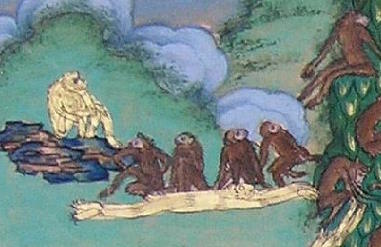
The warriors strung their bows with arrows and began to shoot, all the while yelling war cries to frighten away the monkeys. The noise was tremendous and the monkeys were frightened, looking to their king for guidance. Some of the men picked up stones, sticks, and spears and rushed the tree as if attacking a hostile fortress. The Bodhisattva however, seeing that his frightened subjects were depending on him, reassured the group. Quickly climbing to the top of the tree, and in one giant leap, he flew to a nearby hilltop where he found a bamboo cane that was tall, strong, and deeply rooted. Fastening the top of the cane to his feet, and leaving it rooted in the earth, he jumped back to his tree home. Holding a branch of the tree taught, he ordered all the monkeys to evacuate across his body and down the cane to safety. Desperate and bewildered by fear, the monkeys wildly scrambled across the body of the king and down the cane. Although his body grew weak and numb, his mind remained firm, for the survival of his subjects was his only concern.

Witnessing this, the human king and his men became overcome with astonishment. They had never seen such strength and wisdom combined with such great self denial and kindness for others. The human king ordered his men to stop attacking. Seeing that the great monkey would not be able to hold his position much longer, as the hordes of frightened monkeys had bruised and torn their leaders limbs, the king ordered a canopy be held up to catch the monkey when he fell. After the monkey landed in the canopy, the king had him carefully lifted onto a soft couch. As he lay there unconscious from pain and exhaustion, the human king had the monkey’s wounds salved and washed with butter and medicinal ointments and before long he recovered his senses.

The human king approached, full of curiosity, admiration, and respect, and asked the great monkey who he was in relation to all the monkeys he had saved. To his great surprise, the monkey replied that he was their king. He explained that as their ruler, he was bound to them with the same affection that parents have for their children. The shocked king retorted that subjects are meant to serve their king and not the other way around, and then inquired why he would dare sacrifice himself for mere servants. The monkey stated that he was unable to overlook suffering in strangers, much less kin, and especially not in those who are intent on looking to him as their leader. He explained to the man that although his body was broken, his mind is totally sound, and that he would happily and patiently wait through the pain of his injuries because the discomfort was nothing in comparison to the joy of saving his subjects. He then asked the human king to look at all that has come from his physical sacrifice, he had now achieved satisfaction, serenity, fame, and even the admiration and honor of a king of men! He continued to explain to the human king that a ruler who does not know kindness will never know such virtues and will in fact, obtain their opposite.

The Monkey Kings last words to the human king was that he must always protect his kingdom with spiritual truth, and to view all subjects, from officials to peasants, humans to animals, as if they were his own children. The great Monkey King then peacefully passed away and ascended into the heavenly realms.

by Monty McKeever
A Tribal Reflection On Connecting To Our Roots

“A TRIBAL REFLECTION ON CONNECTING TO OUR ROOTS”
by Elizabeth Jackson

The-Garden-of-Earthly-Delights-Hieronymus-Bosch-Detail-fine-art-16007700-525-5992

Connecting deeper to our roots will enhance meaning and happiness within our lives. Our roots represent where we come from: the earth, the womb, our tribal ancestors, our personal life history, and the modern tribes and surroundings that we live in on a daily basis. The tribal characteristics that develop through studying our roots are a blessing available to us all.

Mother earth is the universal ground for our roots. All that we do rests upon her. Situated at the base of our spine rests the foundation for the entire chakra system, the first of the main 7 chakras in our body. The Sanskrit name for this first chakra is muladhara, meaning “root support.” Our first charka roots us into our body, the physical world, and the earth. To connect with muladhara is to connect with Mother Earth and become grounded in the biological reality of existence.

Human life is dependent upon a supply of energy. Our roots can be seen as the way our system plugs into the larger system of the planet, which is our source, the origin of the liberating current from which all things grow up. The elements needed for physical survival come from the earth in various forms-the food we eat, the water we drink, the air we breathe. Just as a plant grows roots into the earth and absorbs it’s nutrients to then sprouts life above, our connection to our root chakra effects our ability to create strong flowering and fruitful lives. We must have soil firm enough to provide stability, yet yielding enough to be penetrated by roots. Everything that grows above branches out into infinity, growing more rich and complex.

Learning about our roots brings us into a singular simplicity, and anchors us into the commonality of the collective unconscious. To bring muladhara to consciousness is to bring awareness to our roots, to uncover and examine the past in order to become happier and more satisfied in the present. It brings us home to the earth from where our spirit was born and where our body will one day rest in peace and turn to dust.

Our work begins from the ground up, yet it is always changing as a result of what we build above it. Connect to the very ground from which you were born and deepen the meaning and power of the tribe(s) you were born from, as well as, the ones you currently belong to and will continue to develop throughout the remainder of your life. Feed your tribal journey on earth by remaining an open system in constant exploration and contact with your environment.

-“the privilege of a lifetime is being who you are” -Joseph Cambell

The following is a list of self-reflective questions to help increase awareness of your tribal connection with your first chakra:

1) What are the characteristics of your tribal roots?
2) What does a tribal sensation feel like?
3) What are your tribal environments in life?
4) How is your “tribal-being” being enhanced by these environments and groups?
5) What tools do you use to improve upon sharing your tribal connections with your day-in/day-out various communities that you enter upon? This includes Mother Earth.

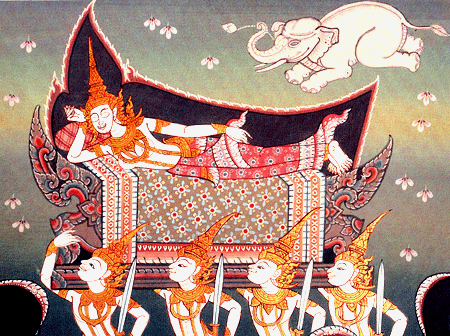
The Elephant (Jataka #1)

This post will kick off the beginning of a series of Jatakas that will be posted to ElephantTribe. Jatakas are short stories from India that tell of the past lives of the Buddha. The overall structure of the Jataka Tales is all about the cycle of samsara (cycle of birth, death, and reincarnation) that the Buddha had to experience before reaching enlightenment.

The Elephant

A Tale of Self Sacrifice.

At one time, the Bodhisattva took birth as a large Elephant. He lived in a forest far from civilization. The forest contained a lake that was both deep and wide and the entire wilderness was surrounded on all sides by an expansive desert. This beautiful oasis was well suited for the elephant as well as other smaller creatures. Delicious fruit grew on the trees, young shrubs carpeted the earth, and the whole area was bordered with high mountains. The Elephant lived alone as an ascetic and sustained his large body only on leaves and lotus roots, dedicating his time to contemplation on the virtues of contentment and tranquility.

One day while wandering along the forests edge, the Bodhisattva Elephant heard the cries of humans coming from the desert. Their cries began to get louder; surely they were approaching the oasis.

Urged by compassion, he ran towards them swiftly and when they came into sight he saw that it was a large group of men, women, and children, all nearly dead from starvation and thirst. Noticing that they were fearful of him, he called out in a human voice and stated that they need not be frightened. Upon hearing such peaceful and comforting words the people regained their composure and humbly greeted him.

The elders explained that they had been banished by an angry king and that many of them had already died in the desert. The kind Elephant realized that all the fruit in the forest would not be enough to feed them for even a day. He resolved that he must offer his own flesh as food and his organs and intestines as bags to carry water on their journey. He then instructed the people on how to find the great lake and said that just beyond it they would find the corpse of an elephant that had fallen from a mountaintop, not telling them that it would be his own corpse. As the group set out towards the water, he quickly, by another route, started to ascend the mountain. Upon reaching the top he then, feeling great joy and oblivious of the impending painful death below, hurled himself over the edge of the precipice. The impact sounded like an earthquake throughout the entire forest.

Meanwhile, the group of exiles had reached the lake and refreshed themselves with the cool water. Following the Bodhisattva’s directions, they discovered the body of an elephant not far away. At first, they were surprised that the corpse so closely resembled the kind Elephant they had just met. Before long, a clever one in the group determined that it was in fact the same Elephant. Awestruck by the incredibly generous and selfless act of the great beast, they burst into tears of gratitude.

Some in the group thought that they should not eat such a great Bodhisattva, stating that such a magnificent and compassionate being deserves nothing less than a proper cremation ceremony. Once again, the clever one explained that the true way to honor the elephant would be to eat his flesh as the Elephant had intended. The people ate until they were full, made bags to hold water, and crossed the rest of the desert without trouble.

by Monty McKeever 2005